
Flourish Psychiatry
Relational psychiatry in the age of AI
This is my work on psychiatry, neurodivergence and AI, set out in an accessible form. I’m Dr Paul Collins, a psychiatrist working in NHS crisis and home treatment. Each page is short, and links on to the wider context my ideas sit within and the fuller pieces behind them, for patients, families, clinicians and anyone trying to make sense of distress.
Nothing here is for sale. I don't offer private work or services through this site, and there are no affiliate links. It is not medical advice. If you need help now, see the crisis information at the foot of every page.
Start with a breath
Before any of the ideas on this site, there’s something simpler. First Breath is a small app I built: choose a rhythm, follow the shape on the screen, and let your breathing slow down with it. It’s my clearest way of showing what this work is about: starting from the body and what you can notice for yourself, before any label. It’s free, needs no account, and works on a phone.
An experiment, not a treatment. If a hold feels uncomfortable, just breathe normally. If you need help now, call 999, NHS 111 (option 2) or Samaritans on 116 123.
The position in brief
For decades, many clinicians and researchers have questioned whether psychiatric diagnoses are natural categories, and whether distress is best understood as a broken brain waiting to be chemically corrected.
AI changes the ground it stands on. For the first time, a clinician can hold the person’s context in mind before seeing them and, eventually, this will include the whole written record of a person’s life with services: years of letters, notes, and summaries that no busy human can read in full.
That can go two ways. AI could read the record as it stands, count every repetition of a label as confirmation, and turn old diagnoses into fluent summaries that are harder to question. Or it could keep sources, disagreements and time visible, so that a careful clinician can see how someone's difficulties developed over a life, and the person can see it too.
As I put it in Psychiatry After the Diagnostic Object: "The choice is one of architecture, not of capability." My concern is that AI could lock old labels into a solid, immovable, inflexible and unarguable, self-confirming conformity. This site sets out the arguments and the evidence on both sides.
I hope that we choose a different path; one in which the opportunity to develop a shared and flexible reflective space in which new insights can lead to new understandings and possibilities.
Two ideas behind this site
Mind in a living world. Much of psychiatry still starts from the idea that the mind sits inside the brain, so distress is something to find and fix in there. I start from a different place: a person is a body living among other people, places, history and meaning, and the brain works within all of that rather than ruling over it. The clinical question then changes from "what disorder is this?" to "what is flooding, blocked or stuck in this person's life, and what would help it move again?" I set this out in Psychiatry After the Isolated Brain.
The clinical aperture. Think of consciousness as an aperture that can narrow, widen or change shape, as it does in depression, mania, psychosis or neurodivergence. On this view, an unusual or wide-open state isn't the problem in itself. What matters is whether the person can still come back to the shared world: whether they can doubt, rest, eat, stay in touch with the people they trust and change their mind. I call this corrigibility, and it isn't the same as agreeing with the clinician. The model is in The Clinical Aperture, Corrigibility, and the Return to the Shared World.
Both are working frameworks I use to think with, not established theory.
Where this work began
I don't hide where this started. In April 2025, after weeks of ADHD assessments done alone from home and long, intense conversations with an AI system, I went through what a standard mental state examination would have called a manic psychotic episode. I have also called it, more plainly, a burnout, breakdown and breakthrough. I took myself to an emergency department and was not detained. The experience integrated, and it changed how I understand diagnosis, meaning and AI. There's a short account on the About page, with links to the fuller one.
Start here
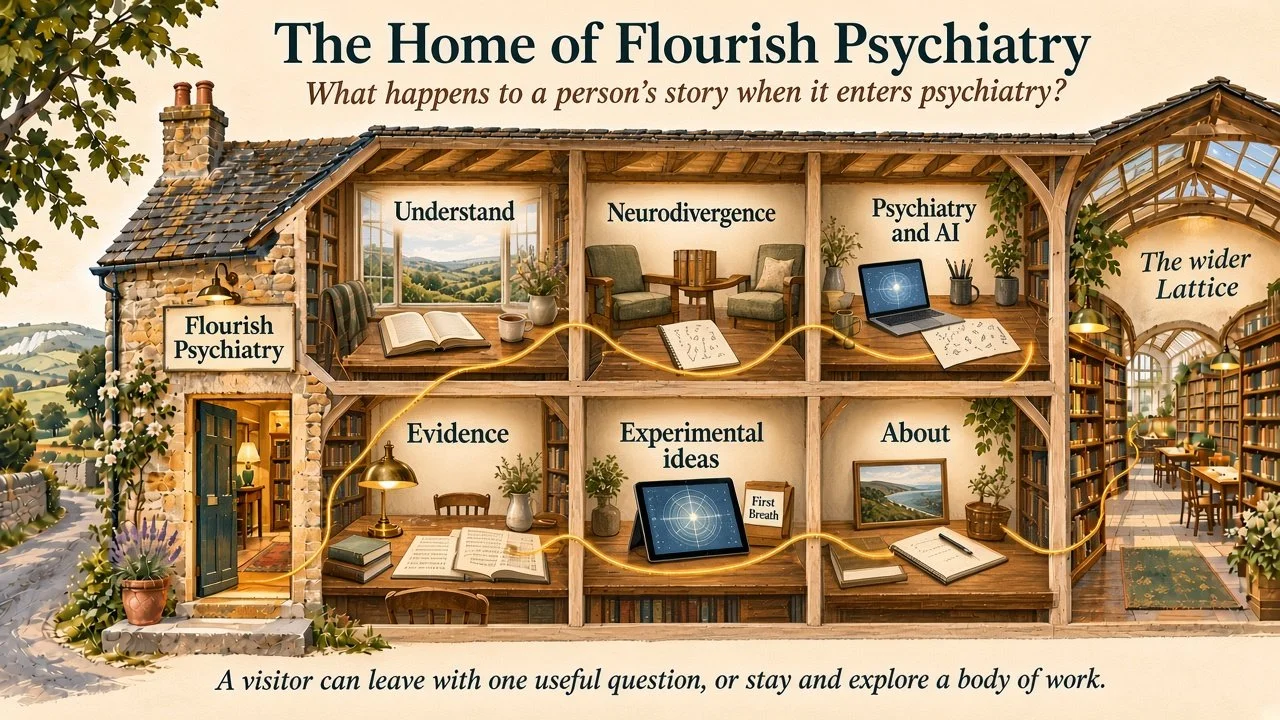
Understand: what I mean by semiocide, the idea that a diagnosis can replace a person's own sense of what their distress is saying.
Evidence: relational psychiatry, Open Dialogue, the Power Threat Meaning Framework, and the debates around medication and psychosis. Each one has two sides, not a verdict.
Neurodivergence: how I think about ADHD and autism, with practical pointers on assessment and adjustments at work.
Psychiatry and AI: how AI could harden copy-pasted diagnoses into an unquestionable record, why the choice is one of architecture, and why access to your own story matters.
Experimental ideas: prototypes I have built. They are experiments, not clinical products.
About: who I am, my current role, and the standards this site follows.
A practice: holding mind in world
When life becomes overwhelming, attention can shrink to a tight loop of task, worry, self-criticism and symptom, until the problem feels total. One practice I've written up starts somewhere simpler: the body, and the place you're in.
It has five plain steps: arrive in the body, widen into the environment, notice what you're in relation with, let meaning come without forcing it, then return to ordinary life with one small, practical next step. A walk helps, but any street, garden or doorstep will do. The point isn't beauty, and it isn't forced calm.
It isn't a replacement for care. If thoughts start to speed up rather than settle, or sleep goes, stop, rest and talk to someone you trust.
The full guide, for patients, carers and clinicians, is here: Embodied Ecological Mentalisation.
Going deeper
If you want the longer writing, two maps of it are available. Neither is needed to follow what’s here.
The Lattice of Gamma Sites: a map of my published essays and sites, with a plain front door for newcomers
Apps and Tools: a guide to the interactive pieces I have built.
How this site works
Sources are linked where claims are made. Opinion is labelled as opinion. Pages are dated, and corrections are made openly and dated, never silently.
Last updated: 20 November 2026.